

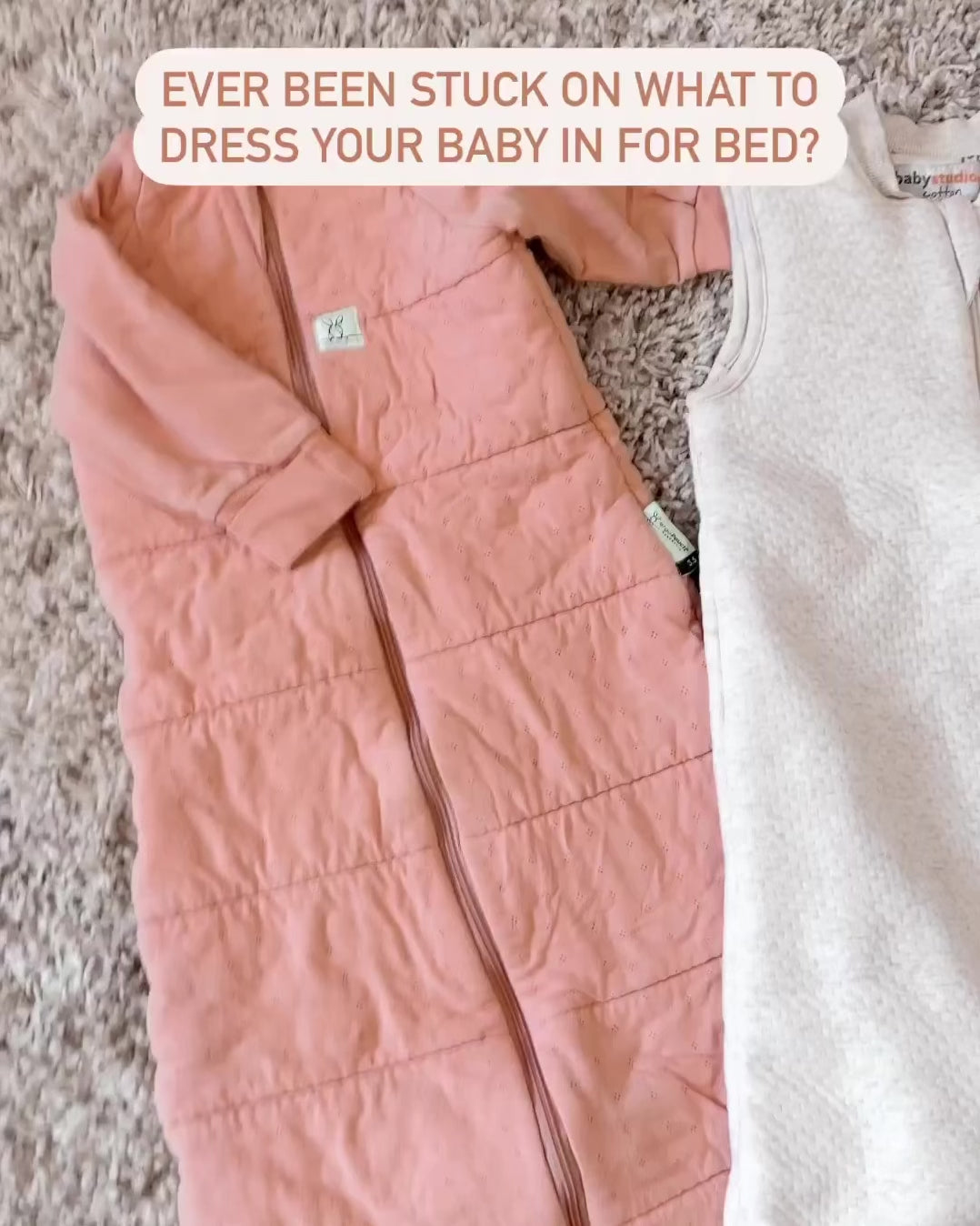





The Nightly TOG Battle: Why You're Doing the Same Mental Math Every Single Night

 From our Sleep Experts Blog: this article was written by Lauren Brimblecombe from The Conscious Parenting Co. to help parents feel more confident choosing their baby’s sleepwear for the night ahead.
You’re getting your baby ready for bed. They’re warm and cosy after their bath, fresh sleepsuit on, and then you pause: is it a 1 TOG, 2.5 TOG, or 3.5 TOG night?
You check the app. You check the monitor. You think about what it felt like outside today versus what it’s going to feel like at 3am.
And then you do the SAME THING. EVERY. SINGLE. NIGHT.
Unless you’re a parent, you genuinely cannot understand the mental load that comes with this nightly dresswear battle.
It sounds like such a small decision from the outside — it’s just an outfit, right? But when you’re already running on empty, having to solve a mini temperature puzzle at 7pm, every single night, adds up.
So let’s actually talk about why this matters so much, and why it’s worth getting right.
What’s Actually Happening in Your Baby’s Sleep
Your baby’s longest stretch of sleep happens overnight, and following the 4-month regression, that sleep becomes organised into distinct cycles — non-REM sleep, which dominates the first half of the night, and REM sleep, which takes over in the second half.
REM sleep cycles are lighter, more shallow, and shorter.
Which means it is completely normal — expected, even — to see more wakefulness in the second half of the night. This isn’t a sign something’s wrong. It’s just how sleep architecture works once your baby moves past the newborn stage.
But here’s the added challenge: at the exact same time your baby is moving into these lighter, more wakeful sleep cycles, the external temperature is also dropping.
The room that felt perfectly warm at 7pm can be a genuinely different temperature by 3am — sometimes significantly so, even with heating running.
Put those two things together — lighter sleep AND a colder room — and you get one of the most common reasons babies wake between 3am and 5am and struggle to settle back down: they’re cold.
Not hungry, not overtired, not “just going through something.” Cold.
The Real Challenge: Dressing for Two Different Moments
Don’t just dress for bedtime — dress with the whole night in mind.
What a challenge that actually is in practice!
Think about it from your own perspective. When you go to bed, you might start out under one blanket, and if you wake up cold at 3am, you reach over and pull up an extra one.
You adjust. You have options.
Your baby doesn’t have that luxury. They can’t pull up a blanket, add a layer, or nudge the heater on.
Whatever they’re dressed in at bedtime is what they’re working with for the entire night — through the warmer evening hours and the coldest pre-dawn stretch.
This is exactly why “dress for now” isn’t really the right approach. You need to dress for where the temperature is going, not where it currently sits.
What to Do When the Room Feels Too Warm at Bedtime
This is the catch that trips up so many parents, and it’s worth naming directly: what do you do when the room is warm enough at bedtime that your baby would be uncomfortable in the layers they’re actually going to need by 3am?
It’s one of the trickier parts of the puzzle, but there are a few practical ways to work through it.
Start with the sleeping bag. A TOG-rated sleeping bag is your best friend here because it provides consistent warmth without the risk of loose layers — and it works across a temperature range rather than being pinned to one moment in the night.
If the room is warm at bedtime but expected to cool overnight, choosing the right combination can feel like a balancing act.
The goal is to find a TOG and clothing combination that will keep your baby comfortable as the room temperature changes throughout the night, rather than dressing only for how the room feels at bedtime.
Think practically about the room itself. Could you cool the room down a little at bedtime to allow you to dress your little one a bit more snugly? Or on the flip side, is there a way to take the edge off the colder stretch later in the night?
In winter, many families heat the house beautifully in the evening and then everything switches off overnight — worth thinking about how that plays out specifically in your baby’s room.
In summer, cooling the room down earlier can be just as effective: air conditioning, drawing the blinds in the afternoon to block heat building up, or even opening a window if there’s a nice cool breeze coming through.
There’s no one-size-fits-all answer here — it really does depend on your home, your set-up, and whether your little one tends to run warm or cool.
Materials matter. A short-sleeve onesie under a long-sleeve sleepsuit might feel like too much at 7pm, but if the room is going to be significantly cooler by 3am, those layers work together across the night.
Breathable fabrics — cotton especially — are your friend here. They don’t trap heat the way synthetic fabrics can, which means your baby is less likely to overheat at the warmer end of the night while still having that extra layer to draw on when the temperature drops.
The goal is that comfortable middle ground — warm enough for the coldest part of the night, without being too much at bedtime.
It’s a balance, but once you have the right information about where your baby’s room is actually heading overnight, it becomes a much easier one to strike.
Why Knowing the Prediction Changes Everything
This is where understanding the predicted overnight temperature for your baby’s specific room becomes such a game changer.
When you know what your baby’s room is actually going to drop to overnight — not just what the outside weather will do, but what the room itself will experience — you can dress your baby to support them through that entire window.
No waking up at 1am to add a layer. No fumbling in the dark trying to figure out if you should turn the heater on. No guessing.
It also means you stop relying on “what worked last night,” because rooms don’t behave identically every night.
A clear, cold night behaves differently to an overcast one. A heater running on a timer behaves differently depending on what time it switches off.
The variables shift constantly, which is exactly why so many parents feel like they’re starting from scratch with this decision every evening — because in a way, they are.
Where Sleep Like Goldilocks Comes In
This is exactly the problem Sleep Like Goldilocks set out to solve.
It doesn’t just give you the predicted weather for your area — it gives you the predicted temperature specifically for your baby’s room.
How clever is that?
From there, it provides personalised sleepwear guidance based on your baby’s room temperature, helping you dress your baby comfortably for the whole night — from the cosy warmth after bath time right through to the coldest stretch before sunrise.
No more standing at the cot doing mental gymnastics. No more middle-of-the-night layer negotiations.
Just a clear answer, based on your actual room, your actual baby, and what’s coming overnight.
The Bigger Picture
At the end of the day, this isn’t really about TOG ratings or temperature charts.
It’s about reducing one more decision in a day that’s already full of them.
It’s about giving your baby the best chance of staying comfortable through that vulnerable 3–5am window, and giving you confidence that you’ve dressed them for the night ahead.
And it’s about you getting to go to bed without that nagging “did I get it right?” feeling.
Because parenting already asks so much of you. The nightly TOG battle doesn’t need to be one more thing you’re solving from scratch, every single night, for years.
Take the Guesswork Out of Dressing Your Baby for Sleep
Sleep Like Goldilocks shows you the current and predicted temperature of your baby’s room and provides personalised sleepwear guidance for the night ahead.
Not too hot. Not too cold. Just right.
Discover Sleep Like Goldilocks